AI Images Are Everywhere. Here’s Why Your Brand Should Use Them Carefully.
Not long ago, it was easy to spot a business that had invested in professional photography or custom graphic design. But today that’s getting much harder.
With tools like ChatGPT, CoPilot, and Canva AI making image creation faster than ever, we’re seeing AI-generated posters, social media graphics, and website banners pop up everywhere. For small businesses with limited time and budgets, it’s easy to understand the appeal. You can create something polished in minutes without needing graphic design experience or hiring a graphic designer to do it for you.
But just because you can generate an image doesn’t always mean you should. In a previous blog post, Why Authentic Beats Perfect When It Comes to Social Media, we talked about how audiences are increasingly drawn to businesses that feel genuine rather than overly polished. That same principle applies to AI-generated visuals.
Here’s why it’s worth using AI thoughtfully instead of relying on it for every piece of content.
Overreliance on AI Causes Your Brand to Lose What Makes it Unique
Your business isn’t just a logo. It’s your personality, your story, your people, and the little details that make customers remember you.
However, AI doesn’t know those things. Unless you’re carefully directing every prompt and editing every result, AI-generated images often default to the same polished, generic style that thousands of other businesses are using. Before long, your social media presence starts to look like everyone else’s.
The strongest brands are recognizable without needing to display their logo. Consistent photography, colours, typography, and design choices all work together to create that recognition. AI can certainly support those efforts, but it shouldn’t replace them.
People Are Becoming Increasingly Better at Spotting AI
A year or two ago, AI-generated images felt new and impressive. Now they’re becoming surprisingly easy to recognize.
Extra fingers. Strange lighting. Impossible reflections. Perfectly symmetrical smiles. The overly dramatic lighting. Once you’ve noticed the pattern, it’s hard not to notice it.
More importantly, audiences are starting to associate obviously AI-generated content with lower effort and lower trust. Research from Major Tom found that many Gen Z consumers can quickly identify AI-generated marketing and often describe it as feeling generic or inauthentic. Rather than being anti-AI, many simply want brands to demonstrate genuine effort and maintain a human voice.
That doesn’t mean every customer will stop buying from you because you used AI. It does mean that if your business depends on relationships and trust, authenticity is becoming an increasingly valuable competitive advantage in the current age.
“Many Gen Z consumers can quickly identify AI-generated marketing and often describe it as feeling generic or inauthentic. Rather than being anti-AI, many simply want brands to demonstrate genuine effort and maintain a human voice.”
If Everyone Uses the Same Tool, Everyone Starts Looking the Same
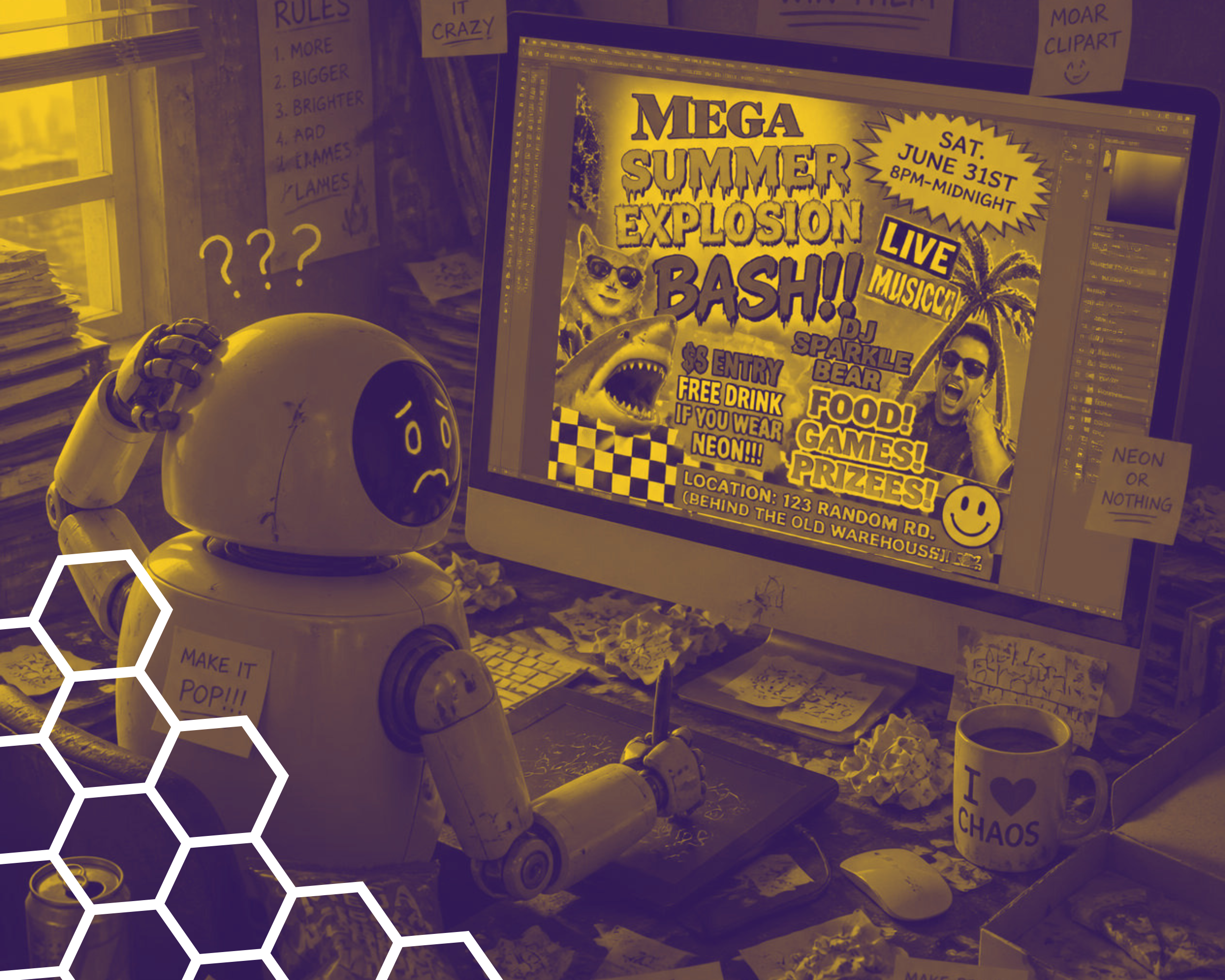
Think about scrolling through social media. How many AI-generated event posters have you seen lately? With bold glowing text, floating objects, and perfectly lit people, there’s a reason they all feel familiar.
As generative AI becomes more common, it also becomes more predictable. Publications and designers have even begun referring to the rise of nearly identical AI promotional graphics as a “ChatGPT flyer” trend because so many businesses are producing visuals with the same recognizable style.
Marketing works best when people remember your business. Not when they remember that you used AI to create it.
Your Visuals Reflect the Quality of Your Business
Whether we like it or not, people make quick judgments.
If someone feels you’ve cut corners on your marketing, they may wonder where else you’ve cut corners. That’s especially true for businesses selling premium products or professional services.
Now, we’re certainly not saying every business needs a professional photographer or designer for every Instagram post. Budgets are real, especially for small businesses.
But investing in high-quality brand photography, custom graphics, or professional design when and where it matters, such as your website, homepage banners, service pages, and major campaigns, can reinforce your credibility in ways AI often can’t. So sometimes it can be a good idea to invest in professional photography for these types of items. (We recently splurged on a shoot ourselves! Read our blog post The Power of Visual Branding: Why Your Business Needs Customized Photography Instead of Stock Photos if you want to learn more about our experience).
The bottom line is this: think of AI as a helpful assistant, not your creative director.
Know Your Audience
AI is a very hot-button and controversial topic at the moment. Not every audience reacts to AI the same way. Some customers may not notice or care that an image was AI-generated. Others absolutely will, and won’t be afraid to say it.
Younger audiences, particularly Gen Z, have grown up surrounded by AI tools and are often much quicker at identifying AI-generated content. Many actively prefer brands that feel more human, less manufactured, and more transparent.
If Gen Z is an important part of your customer base, relying heavily on AI-generated visuals may unintentionally create distance instead of connection.
So… Should You Use AI Images?
Absolutely, but with intention.
AI can be an incredibly useful tool for brainstorming concepts, creating placeholder graphics, illustrating blog posts, or generating creative ideas during the design process.
Where we’d encourage a little more caution is using AI to replace the authentic parts of your brand.
A good approach is to find the right balance. Whenever possible, use real photos to showcase the people and personality behind your business:
Use candid photos of your team, workspace, customers (with permission), and products when possible.
If your budget allows, invest in a professional photographer from time to time to capture real, high-quality images for your website and major marketing campaigns.
Then, let AI support your creativity rather than replace it. AI tools can be helpful for:
Brainstorming image concepts when you need inspiration.
Generating mock-ups or first drafts to speed up the creative process.
Creating simple promotional graphics for social media posts or blog articles.
Editing or tweaking existing images
“A good approach is to find the right balance. Whenever possible, use real photos to showcase the people and personality behind your business. Then, let AI support your creativity, rather than replace it.”
It’s also worth remembering that great AI-generated images rarely happen on the first try. It often takes several rounds of refining your prompt before you get the result you’re looking for.
Knowing how to write clear, detailed prompts can make all the difference. Here are a few tips:
Put the most important details at the beginning of your prompt.
Use short, clear phrases separated by commas.
Mention what the image will be used for (social media, website, blog, poster, etc.).
Specify any text that should appear in the image.
Clearly describe what you want the image to feature (a person, an animal, a specific object, etc.).
Indicate the style you’re looking for (illustrated, realistic, minimalist, and so on).
Describe the tone you want (professional, upbeat, humorous, etc.).
When refining an image, change only one detail at a time before generating a new version.
Always inspect the final image closely for common AI mistakes like extra fingers or hands, distorted faces, floating or cut-off objects, inconsistent shadows, misspelled text, or other details that don’t quite look right
The more specific your prompt, and the more carefully you review the final image, the better your results are likely to be.
But, most importantly, keep asking yourself one simple question: Does this still feel like us?
“Great AI-generated images rarely happen on the first try. It often takes several rounds of refining your prompt before you get the result you’re looking for. ”
Technology will continue to evolve, and AI isn’t going anywhere. The businesses that stand out won’t necessarily be the ones using the newest tools, but the ones using them thoughtfully.
Because at the end of the day, your biggest competitive advantage isn’t artificial intelligence. It’s being authentically and unmistakably you.
Need Help Building a Brand That Stands Out?
AI can be an incredibly helpful tool, but it’s no substitute for a strong brand strategy, thoughtful design, and authentic marketing. Whether you’re refreshing your website, creating engaging social media content, or looking to build a brand that truly reflects your business, BuzzMate Marketing is here to help.
We’ll work with you to create marketing that feels genuine, connects with your audience, and helps your business stand out for all the right reasons. Contact BuzzMate Marketing today to learn how we can help bring your brand to life with the right balance of creativity, strategy, and technology.